
Table of Contents
Understanding RBT Data Collection Methods
Understanding RBT data collection methods is essential for tracking client progress in applied behavior analysis (ABA) therapy. Registered Behavior Technicians (RBTs) rely on structured measurement to evaluate behavior change and guide treatment decisions. According to How to ABA, knowing both continuous and discontinuous measurement procedures helps practitioners select the most useful approach for each client.
Continuous measurement procedures involve recording every instance of a target behavior. Frequency counts occurrences—like tallying each time a child initiates a request. Duration measures how long a behavior lasts, such as timing a tantrum. Latency tracks the time between a prompt and the response, like measuring how quickly a child follows a direction. Rate calculates frequency per unit of time, such as words spoken per minute. These methods yield detailed data but require consistent observation.
Discontinuous measurement procedures sample behavior during set intervals. Partial interval recording captures any occurrence within an interval—useful for high-frequency behaviors. Whole interval recording tracks persistence across the entire interval, helpful for sustained tasks. Momentary time sampling notes behavior at the exact interval end, common in group settings. At Yes ABA Therapy, we choose the method that best fits the child’s therapy goals.
All RBT data collection is conducted under the supervision of a Board Certified Behavior Analyst (BCBA). RBTs learn these data collection techniques during certification training, and ongoing practice refines their skills. It’s important to remember that individual outcomes may vary. By applying these methods under BCBA supervision, we create data-driven plans that help children thrive through personalized ABA therapy.
Continuous Measurement Procedures for Real-Time Behavior Tracking
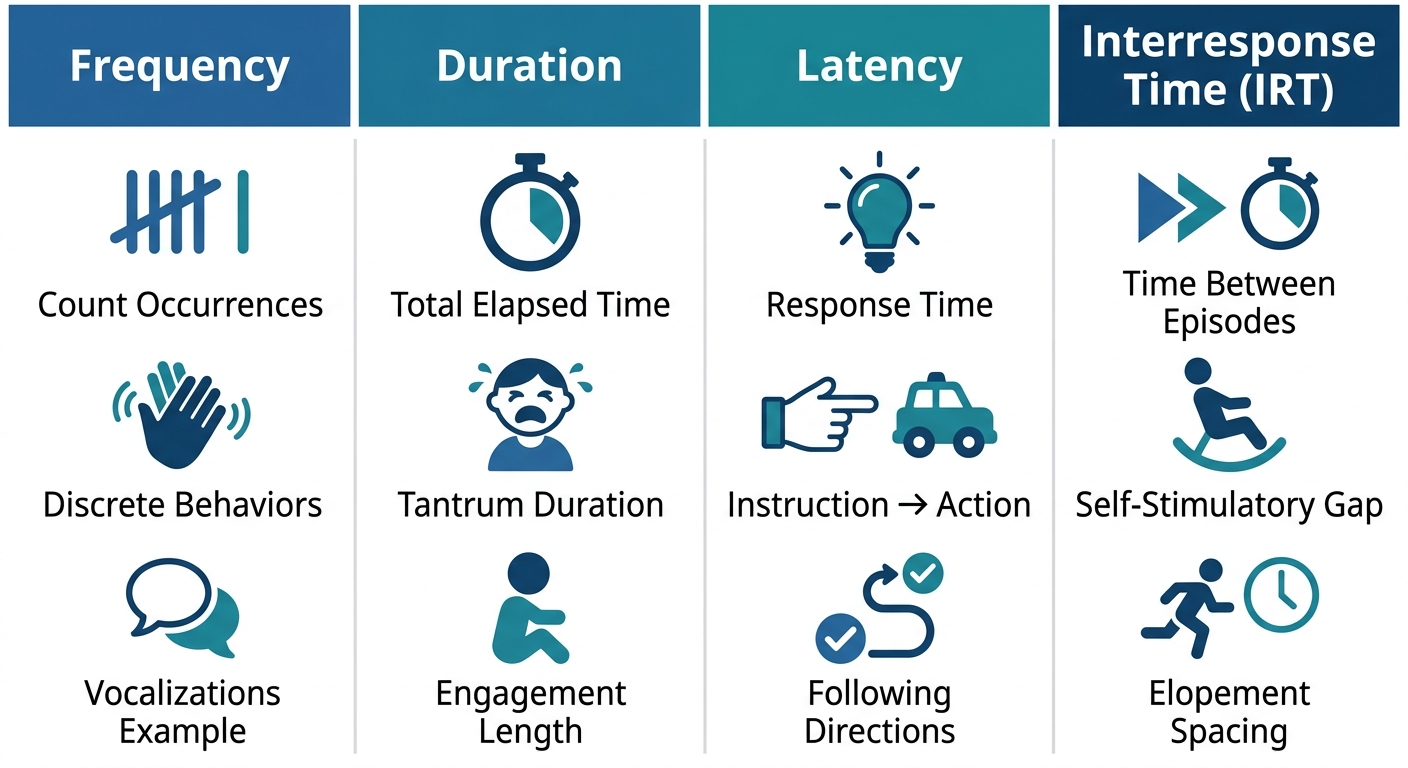
When learning about RBT data collection methods, understanding continuous measurement procedures is essential. These methods capture every instance of a behavior as it occurs, giving us a complete picture of what’s happening during an ABA session. The four main procedures—frequency, duration, latency, and interresponse time (IRT)—each serve a specific purpose in real-time behavior tracking.
| Procedure | Definition | Example in an ABA Session | When to Use |
|---|---|---|---|
| Frequency | Count of how many times a behavior occurs | Tallying each instance of hand-flapping during a 10‑minute play observation | When episodes are discrete and brief (e.g., vocalizations, aggression) |
| Duration | Total length of time a behavior lasts from start to finish | Using a stopwatch to record how long a child engages in tantrum behavior | When behavior lasts a noticeable period (e.g., crying, staring) |
| Latency | Time between an instruction or stimulus and the onset of the behavior | Measuring seconds between saying “Pick up the toy” and the child reaching for it | When response time is a treatment goal (e.g., following directions) |
| Interresponse Time (IRT) | Time that elapses between two consecutive instances of the same behavior | Recording the seconds between two episodes of self‑stimulatory rocking | When the goal is to increase time between problem behaviors (e.g., elopement) |
Choosing the right continuous measurement procedure depends on the behavior’s topography and your intervention goals. As the team at How to ABA suggests, frequency works best for behaviors that are discrete and quick—like vocalizations or aggression—while duration is ideal for longer-lasting behaviors such as tantrums or staring spells. For example, if a child’s tantrum lasts for minutes, recording the total time (duration) helps us monitor improvement over time.
Continuous measurement procedures for real-time behavior tracking
Latency and interresponse time provide insight into response speed and spacing. Latency measures how quickly a child responds after a prompt—crucial when following directions is a priority. IRT tracks the gaps between problem behaviors, which is especially helpful when we want to increase the time between instances of elopement or self-stimulation. At Yes ABA Therapy, we believe that helping children thrive through personalized ABA therapy starts with accurate, real-time data. That’s why our RBTs master continuous measurement methods to tailor interventions precisely. For a comprehensive foundation in these techniques, explore the 40-hour RBT training offered by ATCC Online, which covers these procedures in depth as part of the RBT task list. While continuous measurement captures every instance, there are also discontinuous methods (e.g., partial interval, whole interval) suited for certain behaviors, which we’ll explore next. Always consider individual client needs and consult with your supervising BCBA when selecting measurement procedures.
Discontinuous Measurement and ABC Data in Practice
When continuous measurement procedures aren’t practical, discontinuous measurement helps us estimate how often a behavior occurs. We explore interval methods and ABC recording—core rbt data collection methods every technician should master.
Understanding Discontinuous Measurement Procedures
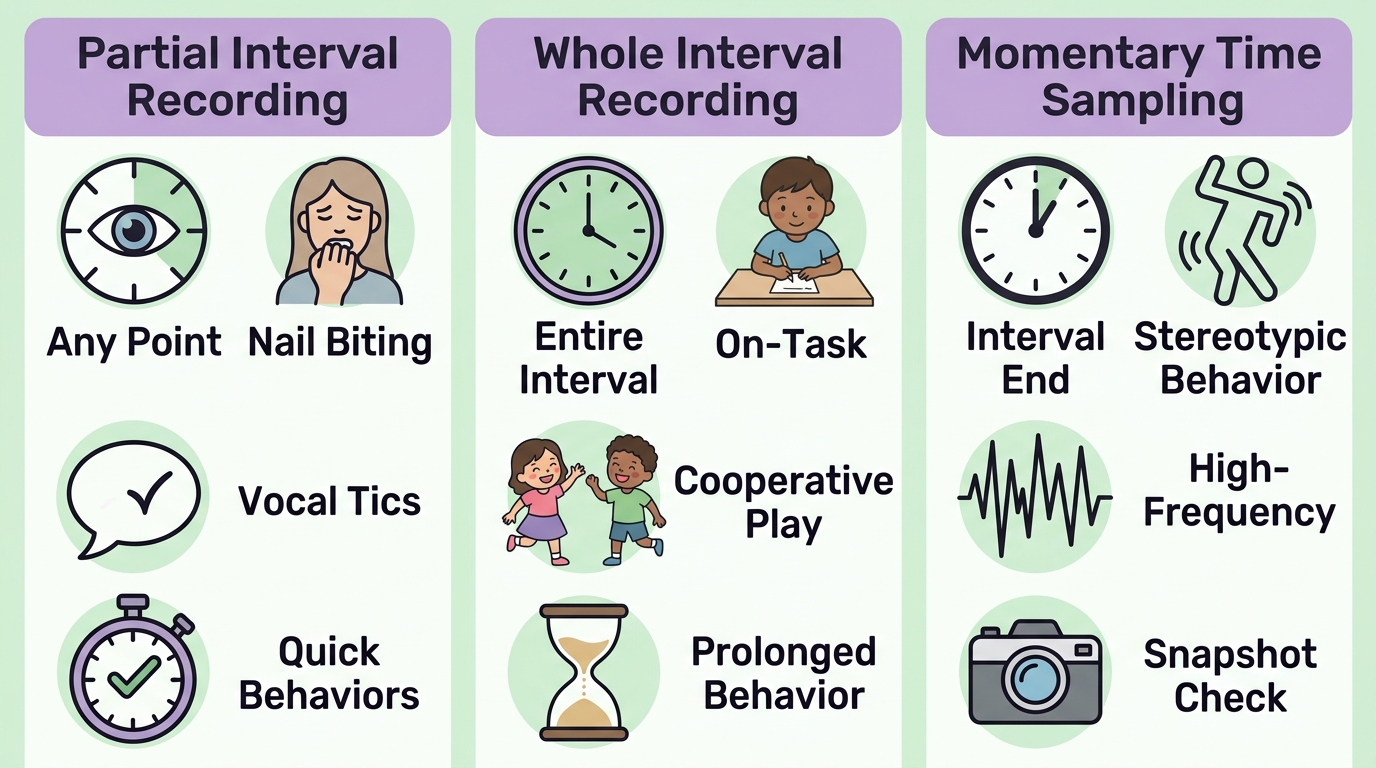
When we can’t count every occurrence, discontinuous measurement procedures help us estimate how often a behavior appears. These interval recording methods split a session into equal time segments and note whether the behavior happens at any point, the whole time, or exactly at the end. The table below outlines the three main types.
| Method | Description | Best Used For | Example in a 10‑minute Session |
|---|---|---|---|
| Partial Interval Recording | Behavior is recorded if it occurs at any point during the interval | Behaviors that are quick and may be missed (e.g., nail biting, vocal tics) | Divide session into 30‑second intervals; mark “+” if hand flapping happens at least once per interval |
| Whole Interval Recording | Behavior is recorded only if it occurs for the entire duration of the interval | Behaviors that should persist (e.g., staying on task, cooperative play) | Mark “+” only if the child is seated for the full 1‑minute interval |
| Momentary Time Sampling | Behavior is recorded at the exact end of the interval | High‑frequency or ongoing behaviors where a brief check is sufficient (e.g., stereotypic behavior) | At the end of each 2‑minute interval, note whether the child is engaging in hand flapping at that exact moment |
Partial interval tends to overestimate, whole interval underestimates, and momentary time sampling gives a snapshot. Choose based on whether you need to detect any occurrence, sustainment, or a quick check—consider the behavior’s typical length and consistency.
Discontinuous measurement methods for RBT behavior tracking
Once we have interval data, ABC recording helps us understand why the behavior happens.
The Role of ABC Data in Functional Assessment
ABC recording techniques give us a window into what triggers and maintains a behavior. We use a simple three-column chart: Antecedent (what happened right before), Behavior (the observable action), and Consequence (the environment’s response). For example, if a child throws a toy immediately after a demand is placed, the antecedent is the demand, the behavior is throwing, and the consequence might be the demand being removed.
Recording these sequences across multiple sessions reveals patterns. According to Raven Health, systematic ABC data collection is a cornerstone of functional behavior assessments. When we see that a child’s tantrums reliably lead to escape from tasks, we hypothesize an escape function. If crying often brings a caregiver over, attention may be the function. Access to tangibles or sensory reinforcement can also be identified. This data doesn’t give us a definitive answer—it guides our hypothesis, which a BCBA then tests and refines.
By combining observational records with careful antecedent-behavior-consequence logs, RBTs build a rich picture that points toward the most effective interventions.
Integrating Multiple Data Sources for Comprehensive Insights
To truly support a child, we blend continuous measurement (for high-rate behaviors), discontinuous measurement (for longer-duration behaviors), and ABC data (for context). For instance, frequency counts might show a child’s vocal tics peak at 30 per session, while ABC records reveal that the tics increase during quiet work periods, suggesting they may serve a sensory regulation function.
This data triangulation helps our BCBAs craft truly individualized plans, whether we’re working in-home, at school, or through virtual ABA therapy. By weaving together interval recordings, event counts, and ABC patterns, we avoid misinterpretation and make evidence-based adjustments. Regular BCBA supervision is essential—our supervisors guide data interpretation, ensure decisions are grounded in sound clinical reasoning, and protect against over-generalization.
Please remember that individual results vary, and all data should be reviewed with a qualified BCBA. For details on how we safeguard your information, refer to our privacy policy. This comprehensive approach sets the stage for developing behavior intervention plans that truly meet each child’s unique needs.
Leveraging Digital Tools and Best Practices for Accurate RBT Data
Now that you understand the different measurement procedures, let’s explore how digital tools can streamline your rbt data collection methods and boost accuracy. From easy-to-use apps to consistent recording habits, the right system helps RBTs capture behavioral data clearly and share meaningful progress with families.
Choosing the Right Data Collection App for Your Practice
Selecting a data collection app starts with evaluating key features that support day-to-day session work. We look for a clean, intuitive interface that allows RBTs to record data with just a tap or swipe, keeping the focus on the client rather than on the software. The app should integrate smoothly with your existing systems—such as electronic health records and scheduling tools—so information flows across one platform without duplicate entry. Real-time syncing is essential for collaboration; immediate cloud updates let BCBAs and other team members see session data as soon as it is entered. Strong reporting and graphing capabilities turn raw numbers into visual trends that guide clinical decisions.
For a comprehensive solution that combines data collection, scheduling, and billing, explore an ABA practice management software like Theralytics—it offers automatic graph generation, cloud sync, and a parent portal that makes sharing progress straightforward. We encourage RBTs and supervisors to trial a few platforms, gather feedback from the team, and choose the one that feels most natural in daily practice.
Best Practices for Consistent and Reliable Data Recording
No matter which measurement approach you use—continuous measurement procedures like frequency counts or discontinuous measurement procedures such as momentary time sampling—consistent recording is essential. We recommend performing interobserver agreement (IOA) checks periodically to confirm that two observers see the same behavioral events. A simple formula (agreements ÷ total intervals × 100) gives a percentage score; regular IOA runs help catch drift early and maintain data integrity.
Equally important is pinning down clear operational definitions for each target behavior. Instead of a vague label like “aggression,” we specify exactly what counts: “any instance of hitting, kicking, or biting another person; does not include accidental contact or tapping to gain attention.” Pairing examples with non-examples removes guesswork for everyone on the team. Finally, following a consistent recording protocol—such as using the same data sheet structure and capturing data at the same time in each session—builds reliability. We often set a timer for 10-minute intervals to prompt data entry, reducing the chance of missed intervals while keeping the session flowing naturally.
Keeping Parents in the Loop: Translating Data into Progress Updates
Keeping parents informed turns raw data into collaborative progress. We commit to sharing updates at least monthly, using easy-to-understand visuals like line graphs with trend lines rather than tables of numbers. In our communication, we lead with empathy: “We know you’re eager to see your child’s growth—here’s what we’ve noticed this month.” We avoid jargon and instead highlight incremental wins, linking each skill to daily life.
A simple graph paired with a brief narrative summary is often more powerful than a lengthy report. Sharing visuals through a secure parent portal lets families follow along between meetings and ask questions in real time. It’s helpful to remember that results may vary based on individual conditions and circumstances, but visual tracking can reveal steady progress over time and reinforce the value of each small step.
As technology reshapes ABA practice, many teams are weighing the benefits of paper versus digital data collection. The following table outlines key differences.
| Aspect | Paper Data Collection | Digital App Collection |
|---|---|---|
| Accuracy | Prone to human errors in transcription and calculation | Automated tallying and built‑in calculations reduce manual error |
| Efficiency | Requires time to write, store, and later re‑enter data | Instant recording and syncing; one‑tap entry saves session time |
| Real‑Time Updates | Data is only available on the paper form; no live view | BCBAs and parents can view data immediately via cloud sync |
| Data Analysis | Must manually graph and calculate trends | Automatic graph generation, trend analysis, and export functions |
| Parent Access | Progress updates require manual summaries or separate emails | Parents can log in to a portal to see dashboards and progress notes |
In settings where reliable internet access is a challenge—such as some in-home sessions or rural locations—paper data sheets can still serve as a reliable backup. However, for telehealth, multi-site agencies, and practices that value real-time collaboration, digital solutions offer clear advantages. Platforms like Theralytics integrate scheduling, data collection, and billing while allowing parents to log in to a secure portal to view progress. Choosing between paper and digital depends on your team’s workflow, client needs, and available resources, but the trend toward digital is unmistakable.
With consistent, reliable data in hand, you’re ready to analyze trends and adjust treatment plans accordingly. The next step is turning those insights into data-driven decisions that move therapy forward.
Ensuring Data Reliability and Interrater Agreement
When we think about RBT data collection methods, it’s not just about gathering information—it’s about making sure that information is trustworthy. Interrater agreement (IOA) is the measure of how consistently two independent observers record the same behavior. High agreement means our data reflects what is truly happening, which reduces bias and supports sound clinical decisions. As part of the broader ABA trends 2026, a strong emphasis on data reliability has become a key priority for providers like us.
To calculate IOA, we use practical methods that match the type of data we are analyzing. Point-by-point agreement compares each instance of the behavior and calculates the percentage of times observers agreed. Interval-by-interval agreement works similarly for interval-based recording, while exact count per interval is ideal when we are tracking the frequency of a behavior within set time periods. Learning these observer agreement techniques helps RBTs identify discrepancies quickly and improve the accuracy of their documentation.
Whether we are using continuous measurement procedures, such as recording the frequency of a response within thirty-second intervals, or discontinuous measurement procedures like partial interval recording, we can adapt our IOA calculations to the data format. For example, we might compare the count of vocal requests two observers logged in each interval, or check whether both marked a self-stimulatory behavior as occurring in the same window. By integrating these checks into our RBT data collection methods, we catch subtle discrepancies before they influence treatment decisions.
At our center, we make IOA a regular practice by running reliability checks during sessions and providing supportive feedback to our team. This commitment to data reliability practices for RBTs helps us fine-tune therapy as each child progresses. Individual treatment outcomes depend on patient factors and clinical circumstances. When our data is solid, it supports that helps your child grow with confidence—enabling us to adjust strategies in real time and celebrate every meaningful breakthrough.
Common Questions About RBT Data Collection
You may also wonder which rbt data collection methods drive your child's treatment plan and how they ensure meaningful progress.
What is RBT data collection and why is it important? RBT data collection is the systematic recording of behavioral data by Registered Behavior Technicians under BCBA supervision, providing objective information that helps our team refine your child’s therapy. RBTs at Yes ABA Therapy are trained to implement these methods accurately, allowing data-driven adjustments without guaranteeing specific outcomes.
What are the differences between continuous measurement procedures and discontinuous measurement procedures? Continuous measurement procedures track every instance of behavior, such as frequency or duration, while discontinuous measurement procedures record samples, like partial interval or momentary time sampling. Our BCBAs supervise RBTs to choose the best rbt data collection methods based on your child’s goals.
To get started with personalized, data-informed care, you can hire an ABA therapist from Yes ABA Therapy. Results may vary based on individual conditions and circumstances.
Building a Foundation with Reliable Data
When we think about progress in rbt data collection methods, we understand that every skill a child develops is captured through careful observation. Our Registered Behavior Technicians use continuous measurement procedures such as frequency, duration, latency, rate, and interresponse time to track every instance of a specific behavior. For example, we record how long a child engages in a task or how many times they initiate a request during a session.
For behaviors that are harder to catch moment-by-moment, we rely on discontinuous measurement procedures like partial interval recording, whole interval recording, and momentary time sampling. These interval-based methods help us sample behavior in natural settings when continuous tracking isn’t feasible, so our Board Certified Behavior Analysts can make informed, individualized decisions. These methods form the backbone of our data-driven, personalized approach to helping children thrive through personalized ABA therapy.