
Table of Contents
Understanding RBT Sessions for Autism
When families begin ABA therapy, RBT sessions for autism are where much of the learning and skill-building happens. An RBT, or Registered Behavior Technician, works directly with your child under the close supervision of a Board Certified Behavior Analyst (BCBA). This partnership ensures every session is guided by a comprehensive, evidence-based treatment plan.
During RBT sessions, we implement behavior intervention plans, teach new skills through techniques like discrete trial training or natural environment teaching, and collect data to track progress. We also coach caregivers to reinforce strategies across daily routines and community environments consistently. The activities are personalized based on your child’s Functional Behavior Assessment, and sessions take place where your child feels most comfortable — whether during in-home RBT sessions, in school-based RBT sessions, or through community-based and telehealth options.
Our RBT sessions are integrated into a comprehensive multidisciplinary autism care approach. We coordinate with speech therapists, occupational therapists, and educators to ensure your child’s goals are reinforced across all settings. This team-based model helps create consistent, meaningful progress.
While every child responds differently, we design and oversee each plan carefully. Results vary based on individual needs, but our commitment to personalized support and collaboration remains at the heart of every session.
The Role of Registered Behavior Technicians in Autism Therapy
During rbt sessions for autism, our Registered Behavior Technicians (RBTs) provide direct one-on-one therapy under the supervision of a Board Certified Behavior Analyst (BCBA). At YesABA, helping children thrive through personalized ABA therapy is our mission, and our RBTs are the heart of that work. These dedicated professionals hold certification from the Behavior Analyst Certification Board (BACB) after completing a 40-hour training program and passing a competency assessment. They work closely with BCBAs, who hold a master’s degree and at least 2,000 hours of supervised fieldwork, to ensure that each session follows a carefully designed behavior intervention plan.
RBTs carry out the day-to-day implementation of ABA therapy, focusing on skill-building goals like communication, social interaction, and daily living skills. They follow the treatment plan created by the BCBA, which is based on an initial functional behavior assessment. While RBTs do not design treatment plans or diagnose conditions, they play a critical role by collecting detailed data during every session. Each of these rbt sessions for autism is personalized to meet the child's unique developmental objectives. Our team uses a variety of RBT data collection methods to track progress, including frequency counts (how often a behavior occurs), duration measures (how long a behavior lasts), and interval recording (whether a behavior happens during specific time segments). These measurements allow the BCBA to monitor progress and adjust the plan as needed. For example, an RBT might record the number of times a child initiates a greeting or the length of a tantrum, providing objective feedback that drives clinical decisions.
Our RBTs deliver therapy in settings that meet your family's needs. Whether it’s in-home sessions in Rockville, school-based support in Montgomery County, community outings, or telehealth sessions, we bring consistent, compassionate care to where your child learns and grows. During each session, the RBT also coaches parents by modeling techniques and suggesting strategies for reinforcing skills at home, because family involvement is key to lasting progress. All RBTs receive ongoing supervision from a BCBA, who reviews data weekly and observes sessions to maintain treatment fidelity and ensure the highest quality of care.
The collaboration between RBTs, BCBAs, and families forms the foundation of effective ABA therapy. At YesABA, we are committed to providing support that helps your child grow with confidence. We celebrate every milestone, knowing that our RBT-led sessions are built on trust, data-driven insights, and a deep respect for each child’s individuality. Results may vary based on individual conditions and circumstances. Please consult a qualified healthcare professional or licensed behavior analyst for personalized advice.
How RBT Sessions Work: Supervision, Settings, and Skill Building
Now that you understand what an RBT is, let’s explore how an RBT session actually works in practice. In RBT sessions for autism, direct therapy is delivered by a trained, supervised technician following a plan created by a Board Certified Behavior Analyst (BCBA). This team-based approach helps children build communication, independence, and daily living skills at their own pace.
To clarify the distinct responsibilities, here is a side-by-side comparison of RBT and BCBA roles:
| Responsibility | RBT | BCBA |
|---|---|---|
| Session implementation | Direct one-on-one therapy delivery | Designs treatment plans and supervises implementation |
| Data collection | Collects trial-by-trial data during sessions | Analyzes data and adjusts programs |
| Supervision received | Receives ongoing supervision from BCBA (minimum 5% of hours monthly) | Provides clinical supervision to RBTs and other team members |
| Program design | Implements programs as written by BCBA | Develops individualized treatment goals and strategies |
| Parent training | Models strategies for parents under BCBA direction | Conducts formal caregiver training sessions |
Source: Behavior Analyst Certification Board (BACB) standards.
With this partnership in mind, let’s examine how BCBA supervision shapes every RBT session and maintains high-quality care.
How BCBA Supervision Shapes RBT Sessions
BCBA supervision is the foundation of every RBT-led session. The RBT and BCBA relationship is central to treatment fidelity, with the BCBA providing ongoing oversight and feedback. Per BACB guidelines, RBTs receive supervision for at least 5% of monthly service hours through direct observation and team meetings to review goals. This ensures RBTs follow the BCBA’s written plan, with no program changes without BCBA approval.
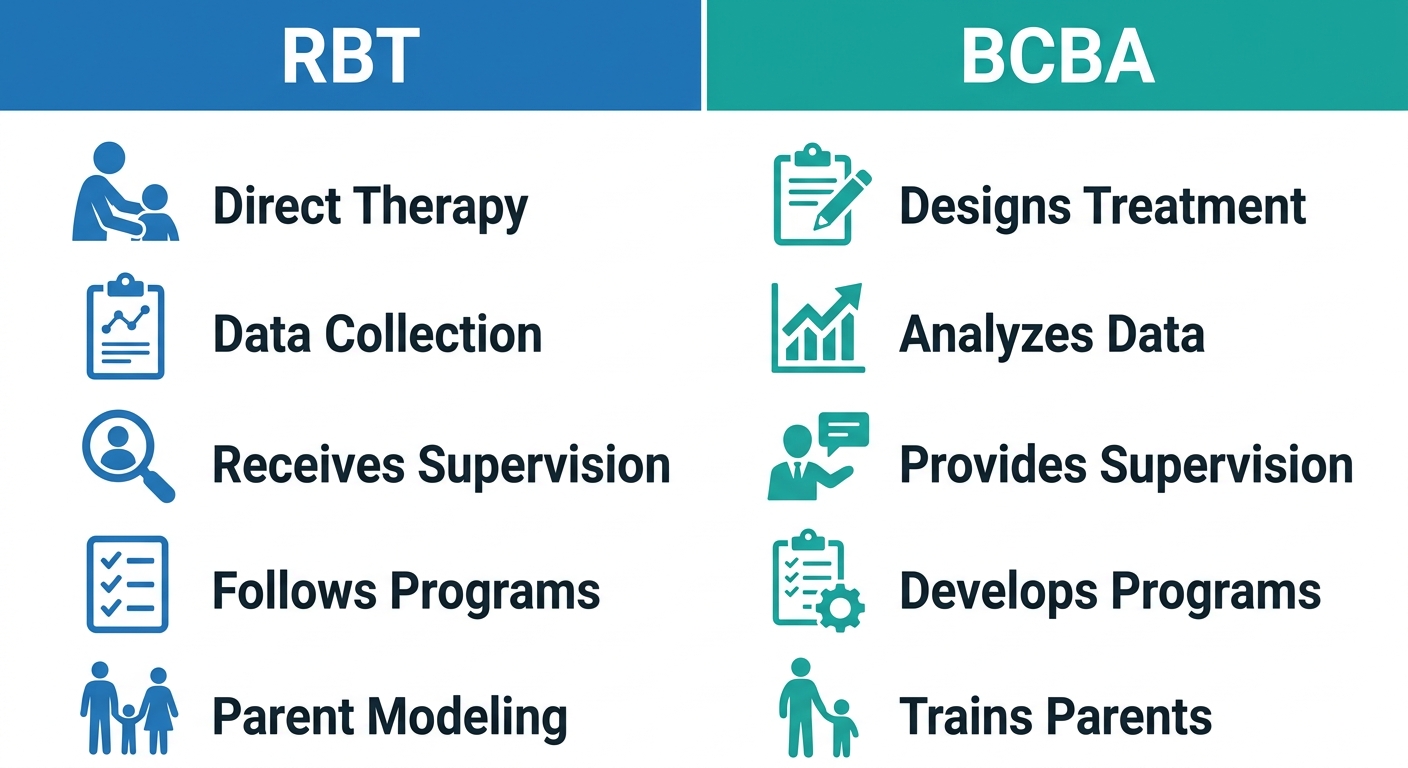
RBT and BCBA responsibilities illustrated in a two-column infographic comparison.
A typical session starts with rapport-building activities to help the child feel comfortable, then moves into discrete trial training or natural environment teaching based on the BCBA’s plan. Throughout the session, the RBT records accurate data on each target behavior. At the end, parents receive a short update and suggestions for practicing skills at home.
Data Collection and Progress Tracking
RBTs use paper or digital data sheets to track every learning opportunity—recording correct or incorrect responses, the frequency of behaviors, and the duration of skill attempts. Many sessions incorporate electronic data collection apps that allow the BCBA to review information in real time or soon after each appointment. Weekly graphs and summaries help the BCBA identify trends and make treatment adjustments monthly or quarterly, ensuring the child’s goals stay on track.
Emerging AI-powered tools are beginning to streamline data entry and pattern recognition, but all analysis and final program decisions remain firmly under the BCBA’s clinical judgment. This blend of technology and expert oversight keeps sessions data-informed and highly responsive to each child’s progress.
Integrating RBT Sessions into a Comprehensive ABA Plan
RBT sessions don’t happen in isolation—they are part of a larger, interdisciplinary ABA plan. Our BCBAs coordinate with teachers to share data and align school support, and they set parent coaching goals so that strategies practiced during sessions carry over into daily routines. The RBT models home-based interventions under BCBA direction, helping families build lasting skills across all environments. Helping children thrive through personalized ABA therapy, this collaborative approach ensures that every setting becomes a learning opportunity.
Understanding how sessions are structured helps families see the value of consistent ABA therapy. Next, we’ll discuss how parents can support session goals at home.
Results may vary based on individual conditions and circumstances. Please consult a qualified healthcare professional or licensed behavior analyst for personalized advice.
Supporting Your Child’s RBT Sessions Across Settings
Now that you understand what RBT sessions involve, let’s explore how to support them across different environments. Supporting your child’s RBT sessions for autism across settings helps build consistent progress and generalization of skills. At Yes ABA Therapy, we believe that the right environment can make all the difference in helping children thrive through personalized ABA therapy.
In-Home and School-Based RBT Sessions
In-home sessions use your child’s natural environment to teach skills within everyday routines such as mealtime, playtime, and bedtime. Because the setting is familiar, your child often feels more comfortable, and you can actively participate and reinforce learning in real time. For families with young children, we offer specialized ABA therapy for preschoolers near me that integrates seamlessly into home life. However, in-home therapy does require a consistent family commitment to minimize distractions, such as turning off screens and setting aside dedicated space for sessions. Our BCBAs will work with you to design a schedule that fits your routine while embedding parent coaching into every visit. We also coach you on using naturalistic teaching during activities like grocery shopping or bath time to generalize skills.
School-based RBT sessions leverage the structure of the classroom and the natural opportunities for peer interaction. Collaborating with teachers and school staff allows us to align therapy goals with educational objectives, helping your child practice communication, waiting turns, and following classroom rules. This collaboration fosters a supportive network, though it requires the school’s agreement and ongoing coordination. Yes ABA’s team can assist in planning the transition from home-based or clinic services to a school environment, ensuring a smooth experience. All school-based sessions remain under BCBA supervision to maintain quality and consistency.
Community and Telehealth Options
Community-based RBT sessions take therapy into real-world environments such as parks, grocery stores, or libraries. These outings provide invaluable opportunities for practicing skills like waiting in line, greeting strangers, or navigating transitions—exactly the kinds of skills that help children generalize what they learn. Community outings expand the reach of RBT sessions for autism by encouraging skill generalization in natural, unpredictable settings. While these sessions may require extra planning and involve more environmental distractions, the real-world practice they offer is unmatched in teaching flexibility and independence. Our BCBA will accompany the team on community outings to model appropriate behaviors and ensure safety while still allowing natural interactions. We often use social stories and visual schedules to prepare for these outings, reducing anxiety and increasing success.
Telehealth options give families flexible access to RBT therapy from the comfort of home. Through secure video conferencing, our BCBAs can guide parents through coaching strategies, observe the child’s behavior, and adjust goals in real time. This model reduces travel and scheduling barriers, making it easier to maintain consistency. Additionally, our team provides guidance on setting up a dedicated therapy space and troubleshooting technical issues so that sessions run smoothly. Although telehealth sessions have limited direct interaction between the RBT and child, they are highly effective for parent coaching and ongoing support when reliable internet is available. Yes ABA’s telehealth services ensure that families in areas like Montgomery County, MD, and San Diego, CA can still receive expert guidance.
Parent Involvement and Caregiver Coaching
Active parent involvement is the cornerstone of successful RBT therapy. Working closely with your child’s BCBA, you can set meaningful goals and use reinforcement strategies at home to strengthen what is practiced during sessions. Caregiver coaching provided by Yes ABA empowers you with the tools to support your child in everyday moments—whether during a meltdown at the supermarket or a quiet playtime at home. Simple data tracking, such as jotting down progress on a chart, helps the therapy team adjust strategies quickly and celebrate each achievement.
We encourage families to treat every interaction as a learning opportunity. Consistency across settings is key, and our team will coach you on how to use visual supports, naturalistic teaching, and positive reinforcement in ways that feel natural to your family’s rhythm. Remember, results may vary based on individual conditions and circumstances, but supportive, consistent parenting is a powerful catalyst for progress.
To help you compare the key benefits and considerations, we’ve summarized each setting in the table below.
| Setting | Key Benefits | Considerations |
|---|---|---|
| In-Home | Familiar environment, natural routines, parent participation | Requires family commitment to consistency, potential distractions |
| School | Peer interaction, collaboration with teachers, classroom structure | Requires school agreement, coordination with school staff |
| Community | Real-world skill practice, generalization, social opportunities | Variable environments, need for extra planning, more distractions |
| Telehealth | Flexible scheduling, remote access, parent coaching from home | Limited direct interaction, requires reliable internet, parent involvement |
Each setting offers unique strengths that can be woven together into a comprehensive treatment plan. The best approach often blends multiple settings to match your child’s goals and your family’s routine. At Yes ABA, we work with you to create a cohesive schedule that maximizes learning without overwhelming your family.
If you’ve observed early signs such as limited eye contact or delayed speech, seeking guidance early is important. Yes ABA’s resource on early autism signs for toddlers can help you understand what to look for and when to reach out for a professional evaluation. Early identification, paired with a thoughtful therapy plan across settings, supports the best possible outcomes.
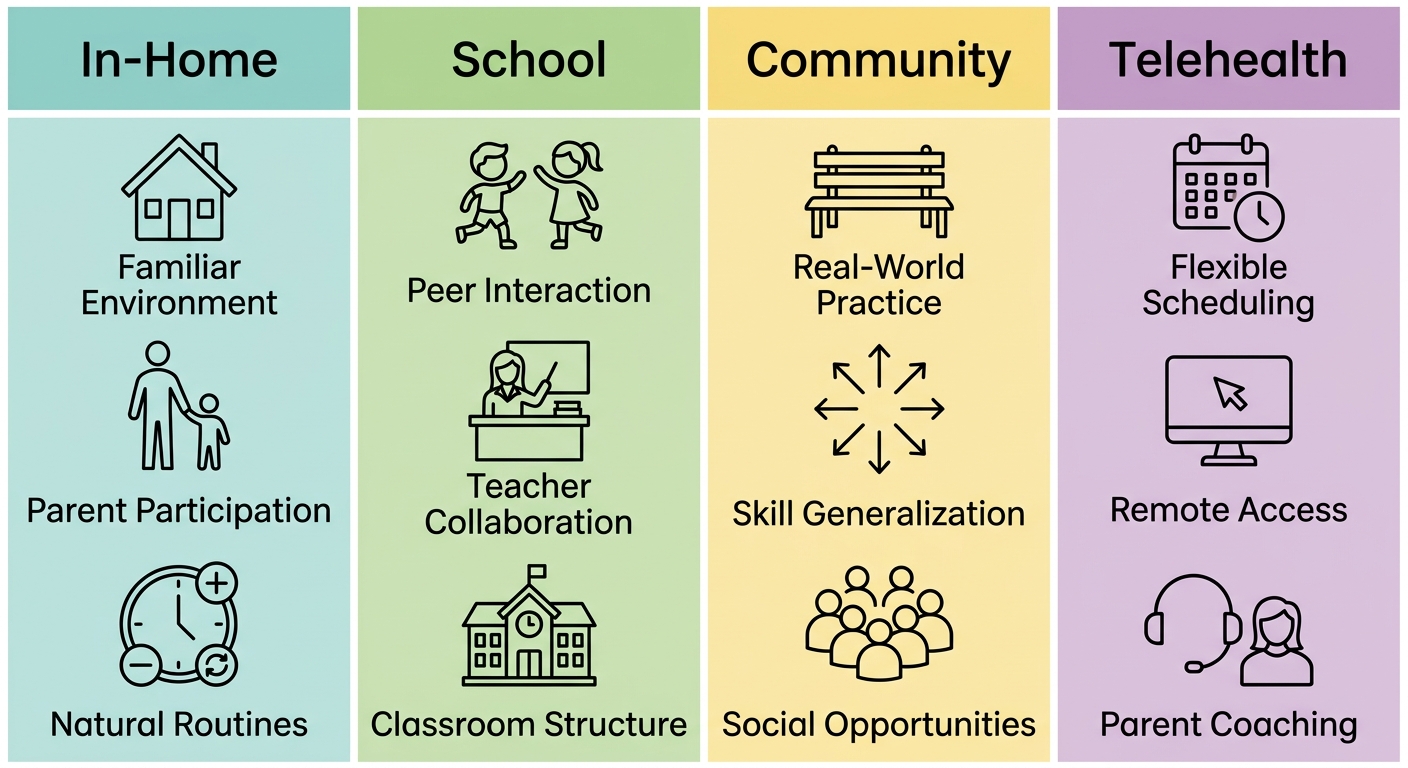
Four therapy settings comparison: In-Home, School, Community, and Telehealth with key benefits.
With the right support, your child can grow with confidence, and we’re here to guide you every step of the way. In the next section, we’ll help you decide which setting aligns best with your child’s unique needs and your family’s routine.
Advanced Strategies for Maximizing RBT Session Outcomes
Building on the fundamentals of effective RBT practice, advanced techniques can transform good sessions into exceptional ones. The most impactful approaches we use in RBT sessions for autism center on real-time data, naturalistic teaching, and consistent caregiver collaboration. These strategies, developed under BCBA supervision, help our clinicians adapt moment-by-moment to each child’s unique responses.
We recommend using trial-by-trial tracking to fine-tune prompting hierarchies during a session. When a client struggles with a target, our RBTs shift from a least-to-most to a most-to-least prompt sequence, ensuring the learner experiences success before gradually fading support. This data-driven pivot keeps frustration low and momentum high.
Embedding skill acquisition into play-based natural environment teaching (NET) is another hallmark of effective RBT-led autism sessions. For example, we might target mands by placing a favorite toy just out of reach during a game, or practice tacting colors while painting together. The child learns without feeling like they’re in a structured drill, which often boosts engagement and generalization.
Behavior momentum is a simple but powerful tool. We start each session with three to five high-probability demands — tasks the child has already mastered — before presenting a more challenging target. This quick sequence builds a pattern of compliance and makes the harder task feel like the next natural step.
Parents are essential partners, so we end every session with a structured two-minute recap. Our RBTs summarize what was targeted, what the child mastered, and one strategy the family can model at home. Tools like Catalyst streamline our digital data collection, cutting paperwork time and letting us spend more of our ABA therapy sessions for children with autism directly engaged with the child. YesABA views these technologies as enhancements to clinical judgment, not replacements for the human connection at the heart of every session.
These advanced strategies create a strong foundation for tracking progress and partnering with caregivers. We believe they help children thrive through personalized ABA therapy, though results may vary based on individual conditions and circumstances.
Frequently Asked Questions About RBT Sessions for Autism
You may have questions. Here are answers.
What is an RBT session for autism? RBT sessions for autism are one-on-one sessions with a behavior technician to build communication and daily living skills under BCBA supervision.
How long does an RBT session last? An RBT session for a child with autism usually lasts 2–4 hours, based on the individual treatment plan.
Where are RBT sessions held? We hold sessions in your home, school, and community settings to support real-world learning.
Are RBT sessions supervised by a BCBA? Yes, a BCBA oversees every session to monitor progress and adjust the treatment plan.
How do I choose the right RBT therapist for my child? Look for BACB certification and autism experience; our guide on hiring an ABA therapist gives more tips.
Building a Consistent ABA Team for Lasting Progress
Consistent rbt sessions for autism are a cornerstone of lasting progress. Helping children thrive through personalized ABA therapy means building a consistent team where your child’s Board Certified Behavior Analyst (BCBA) designs their plan and the same Registered Behavior Technicians (RBTs) deliver individual sessions week after week.
Our clinical guide explains that a stable team prevents regression by allowing genuine rapport to develop. We currently have no waitlist for building a stable, coordinated team around your child, and we provide ongoing parent coaching so everyone works toward the same goals. With a consistent team in place, RBTs can provide focused sessions tailored to your child’s goals.