
Table of Contents
ABA Therapy vs Speech Therapy: Choosing the Right Path for Your Child
Choosing between ABA therapy vs speech therapy can feel like a big decision. As a parent, you want the best support for your child's growth. At Yes ABA, we help families understand how these two approaches differ and how they can work together. Both therapies build critical skills, but they focus on different areas of development.
When weighing ABA therapy vs speech therapy, the core distinction is breadth versus depth. ABA therapy targets skill acquisition and behavior reduction across all developmental domains. Through verbal behavior therapy, we teach communication as part of a broader plan that often includes one-on-one RBT sessions for autism. Speech therapy, in contrast, zeroes in on functional communication, helping children form sounds, understand language, and engage socially. Speech-language pathologists use structured activities and AAC to address these specific deficits. Many children thrive with both approaches, and our team collaborates with speech therapists to align goals. Because every child is unique, a professional assessment by a BCBA and SLP is the best way to determine the right mix.
At Yes ABA, we’re committed to helping children thrive through personalized ABA therapy. Whether you choose ABA, speech therapy, or a combination, we’ll guide you to the right path. Therapy tailored to your needs. No waitlist. Get started today.
Understanding the Core Differences Between ABA and Speech Therapy
When considering aba therapy vs speech therapy, families often encounter two powerful interventions that support communication but come from distinct perspectives. ABA therapy treats communication as a learned behavior, using reinforcement and structured techniques to build language and social skills. Our Board Certified Behavior Analysts (BCBAs) design programs that incorporate verbal behavior therapy, teaching functional communication through manding (requesting), tacting (labeling), and intraverbal responses – helping a child connect with the world around them. This approach targets the underlying motivation and function of language, so skills develop naturally during play, routines, and social interactions.
Speech therapy, on the other hand, focuses on the mechanics of speech. A Speech-Language Pathologist (SLP) works on articulation, receptive and expressive language, pragmatic (social) use of language, and even swallowing disorders. Through articulation drills, language-stimulation activities, and oral-motor exercises, an SLP helps a child produce clear sounds, understand what others say, and use grammar correctly. In short, speech therapy refines the precision and structure of communication.
ABA therapy is overseen by a Board Certified Behavior Analyst (BCBA), a professional certified by the BACB certification board. Speech therapy is typically led by a Speech-Language Pathologist (SLP) or an SLP assistant. Here is a side-by-side look at how the two therapies compare across key dimensions:
| Dimension | ABA Therapy | Speech Therapy |
|---|---|---|
| Primary Focus | Behavioral skills, communication as behavior, functional life skills | Speech sound production, language structure, swallowing |
| Provider | Board Certified Behavior Analyst (BCBA) and Registered Behavior Technicians (RBTs) | Speech-Language Pathologist (SLP) or assistant |
| Methods | Reinforcement, discrete trial training, incidental teaching, verbal behavior therapy | Articulation drills, language stimulation, AAC, oral-motor exercises |
| Setting | Home, school, community, clinic, telehealth | Clinic, school, home, telehealth |
| Target Communication Approach | Functional communication training, verbal operants (mand, tact, intraverbal) | Expressive/receptive language, pragmatic skills, articulation |
The key takeaway from this comparison is that ABA therapy builds the behavioral foundation for communication, while speech therapy sharpens the mechanics of speaking. Because ABA addresses the motivation and function behind language, it can be especially effective when a child struggles to communicate basic wants and needs or to use language socially. Speech therapy then strengthens articulation and comprehension so that language becomes clearer and more structured. Many children benefit from a combined approach: an ABA program develops functional communication skills, and an SLP hones the precision of speech and language. At Yes ABA Therapy, our BCBA-supervised teams weave verbal behavior strategies into everyday routines, helping children gain confidence in using language to connect with others.
Therapy tailored to your needs makes a difference, and support that helps your child grow with confidence starts with understanding what each therapy offers. Results may vary based on individual conditions and circumstances. Please consult a qualified healthcare professional or licensed behavior analyst for personalized advice.
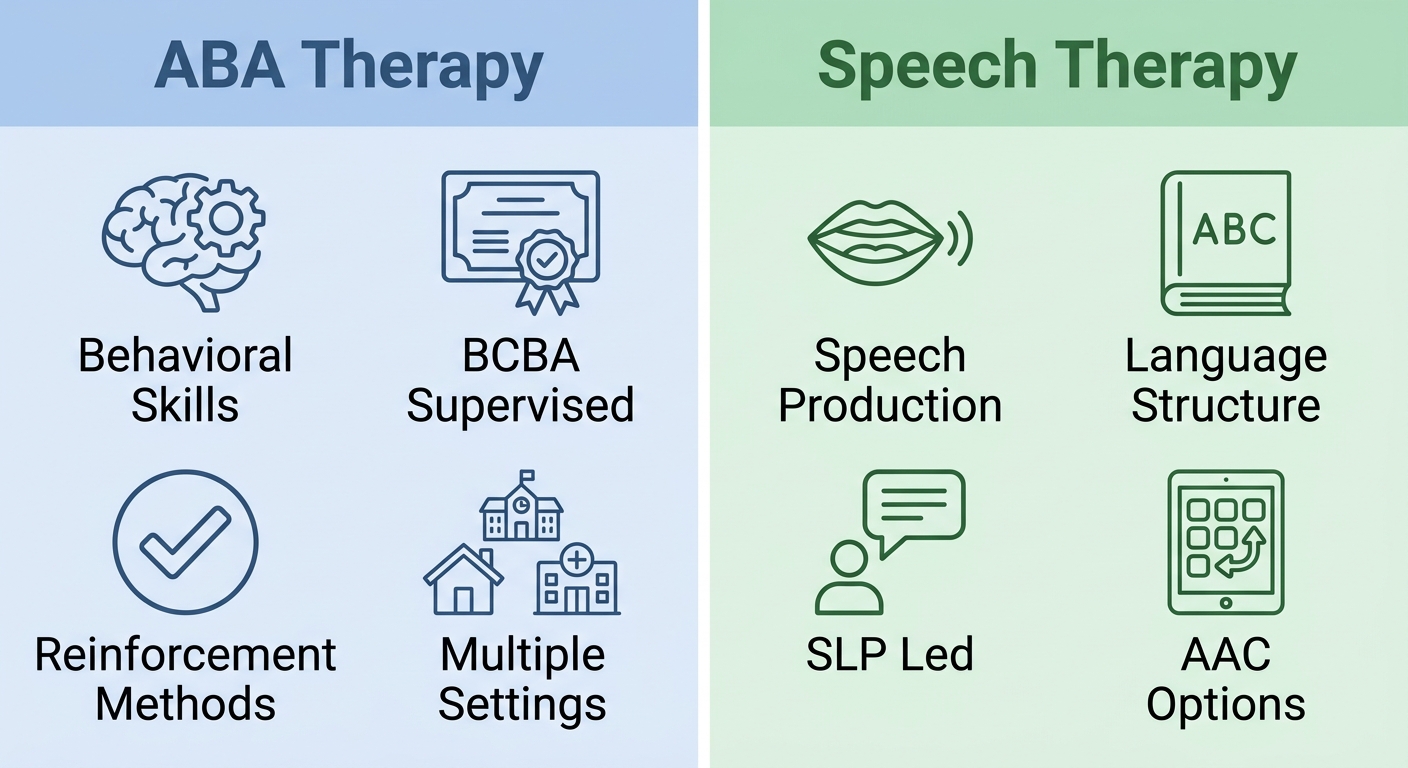
ABA therapy vs. speech therapy: key differences in focus, methods, and providers.
Ultimately, the right therapy depends on a child’s unique profile, and in the next section we explore how personalized ABA programming puts these principles into action.
How ABA and Speech Therapy Work Together for Communication Gains
Combining ABA and speech therapy can unlock greater communication gains than either therapy alone. When families compare aba therapy vs speech therapy, they discover that these two approaches are complementary partners. At YesABA, we see how a BCBA and SLP work together to address both behavioral foundations and speech mechanics, helping children thrive.
Functional Communication Training in ABA
Functional communication training (FCT) is an ABA approach that replaces challenging behaviors with appropriate communication. Instead of tantrums, a child learns to request a break or a favorite item. This directly removes behavioral barriers to speech and language development. By building a foundation of functional communication, children become more available for speech therapy.
Within FCT, we use verbal behavior therapy to break language into teachable units called verbal operants: mands (requests), tacts (labels), echoics (repetition), and intraverbals (conversation). A BCBA teaches a child to mand for “juice,” and the SLP later targets the /j/ sound. This seamless handoff accelerates progress because skills are reinforced across both settings.
ABA also addresses non-compliance and sensory challenges that often disrupt speech sessions. When a child learns to attend and respond to social cues, articulation practice becomes far more productive. Our internal guide to multidisciplinary care emphasizes that integrating ABA with speech therapy from the start leads to faster, more consistent communication gains. We recommend this coordinated approach to families throughout our service areas. In short, ABA removes obstacles to learning while building essential communication behaviors.
Speech Therapy’s Unique Contributions
Speech therapy adds specialized expertise in producing sounds, understanding language, and using tools like AAC. An SLP works on articulation—helping a child say /s/ or /t/ correctly—and teaches receptive skills such as following directions. For non-speaking children, SLPs introduce augmentative systems like PECS or speech-generating devices.
A powerful example of coordination: a BCBA teaches a child to request a toy, while the SLP simultaneously drills the sounds in that toy’s name. Both goals reinforce each other, and the child gets consistent, motivating practice that supports overall communication growth.
Many children benefit when both therapies align in a unified plan. Our 2026 trends analysis also shows that closer collaboration with SLPs is a leading trend, reinforcing why we embed this coordination into every plan. The table below illustrates how ABA and speech therapy contribute across key areas.
Integrated Treatment Plan: ABA and Speech Therapy Contributions
| Integration Area | ABA Contribution | Speech Therapy Contribution |
|---|---|---|
| Communication Goal Setting | Define measurable behavioral communication objectives | Define speech and language milestones |
| Assessment Approach | Functional behavior assessment, VB-MAPP, AFLS | Speech and language evaluation, oral-motor assessment |
| Typical Session Focus | Reinforcing communicative attempts, reducing challenging behaviors | Drilling specific sounds, expanding sentence structure |
| Parent Involvement | Caregiver coaching to embed strategies in daily routines | Home practice for speech exercises |
| Coordination Meetings | BCBA shares behavioral data and functional progress | SLP shares articulation and language data, recommends AAC |
To make this collaboration work, we rely on practical coordination strategies.
Strategies for Combining Both Therapies
First, we use a shared communication log that both the BCBA and SLP update after each session, ensuring everyone stays informed. Second, joint goal-setting meetings during treatment reviews align behavioral and speech objectives. Third, alternating sessions—such as ABA three times a week and speech twice a week—with shared reinforcers keeps children engaged. Families can also streamline collaboration through virtual ABA therapy, which allows BCBAs and SLPs to connect remotely around a child’s progress. These simple but effective habits create a supportive team that moves a child forward.
Together, these therapies help children find their voice. Contact us to see how our integrated team can support your child.
Now that you understand the key differences when comparing aba therapy vs speech therapy, here is a step-by-step framework to decide which therapy—or combination—is best for your child. This structured approach helps you assess your child’s unique strengths, communication goals, and behavioral needs.
A Practical Framework for Evaluating Your Child’s Needs
When evaluating aba therapy vs speech therapy for your child, a structured approach clarifies which path offers the most benefit. We recommend starting with these three steps:
- Assess current communication abilities and behavioral challenges. Observe how your child communicates right now—do they use words, gestures, or alternative methods? Identify any challenging behaviors that interfere with learning, such as tantrums or refusal. These barriers often limit functional communication, making it harder to express wants and needs.
- Define therapy goals that target functional communication. Whether your goal is teaching your child to request a snack, label objects, or hold a conversation, clear objectives guide the therapy choice. For children who struggle to request or label, ABA therapy—especially verbal behavior therapy—directly teaches these foundational building blocks. Verbal behavior therapy breaks communication into teachable units like mands (requests) and tacts (labels), building functional language step by step.
- Review professional assessments with your team. A BCBA can conduct a VB-MAPP assessment to pinpoint verbal behavior milestones, while a speech-language pathologist will evaluate speech production and language comprehension. We coordinate closely with speech-language professionals to align ABA and speech plans, creating a unified approach for your child.
With this information, you can match your child’s profile to targeted recommendations. If significant challenging behaviors block communication, starting with ABA therapy can reduce those barriers so later speech therapy is more productive. For children who have only articulation or fluency issues and no behavioral concerns, speech therapy alone may be appropriate. However, when a child shows limited functional communication—such as minimal requesting or labeling—the combination of ABA (particularly verbal behavior therapy) and speech therapy is often most effective: ABA teaches the function of communication while speech therapy refines the form. For school-age children needing social communication support, both ABA and speech therapy, when strongly coordinated, build social skills and pragmatic language.
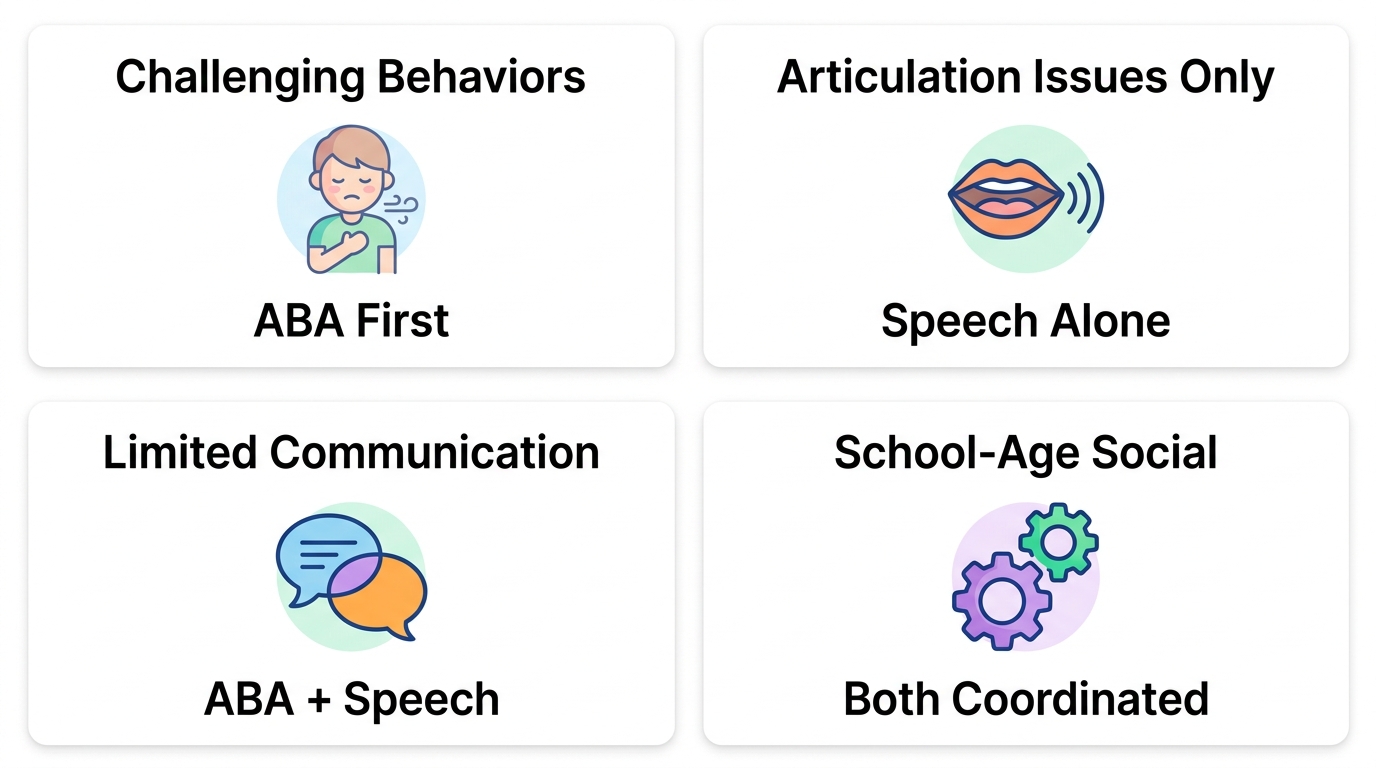
Decision framework: matching child needs to ABA or speech therapy paths
Matching Therapy to Child Profile: A Decision Table
While every child is unique, the decision table below offers a general guide to matching your child’s profile to therapy recommendations.
| Child Profile | Primary Recommendation | Rationale |
|---|---|---|
| Significant challenging behaviors that block communication | ABA therapy first, with possible speech therapy later | Behavioral intervention reduces barriers so speech therapy can be more effective. |
| Articulation or fluency issues only, no behavioral concerns | Speech therapy alone may be sufficient | If no behavioral barriers, speech therapy can focus on speech sounds without ABA supports. |
| Limited functional communication (minimal requesting or labeling) | ABA therapy (especially verbal behavior therapy) + speech therapy | ABA can build foundational requesting and labeling; speech therapy expands language and articulation. |
| School-age child needing social communication support | Both, with strong coordination | ABA targets social skills and behavior; speech therapy targets pragmatic language and conversational skills. |
This framework provides general guidance. For a personalized plan, consult with a BCBA and a speech-language pathologist who know your child. Our team at Yes ABA works closely with families and collaborating SLPs to adjust plans as your child progresses, ensuring that every therapy hour builds momentum toward meaningful communication.
Practical Considerations for Getting Started
When you’re ready to begin, practical factors like insurance, availability, and scheduling matter just as much as the clinical plan. We accept most major insurance plans and verify your benefits at no cost, so you can focus on your child instead of paperwork. Because we maintain no waitlist, you can start therapy quickly—whether in-home, at school, in the community, or via telehealth. Our streamlined intake process and BCBA-led assessments mean you move from decision to action without delay.
Once you decide that ABA therapy is the right next step, we make it simple to hire ABA therapist and begin services quickly. Our care coordinators guide you through every step, providing support that helps your child grow with confidence. Therapy tailored to your needs. No waitlist. Get started today.
Results may vary based on individual conditions and circumstances. Please consult a qualified healthcare professional or licensed behavior analyst for personalized advice.
Coordinating BCBA and SLP Treatment Plans for Integrated Care
Now that we’ve covered the distinct responsibilities of BCBAs and SLPs, let’s explore how their treatment plans are coordinated for truly integrated care. When families compare aba therapy vs speech therapy, they often wonder whether these approaches complement or conflict. In reality, ABA and speech therapy work best as a unified, multidisciplinary effort—each professional brings unique expertise and together they create a seamless plan that reinforces communication skills across all settings. At Yes ABA, we prioritize collaboration right from the start because consistent, aligned strategies can help children make steady progress.
Our integrated approach follows five steps: Initial Assessment, Goal Development, Data Sharing, Regular Meetings, and Parent Communication. During goal development, BCBAs write behavioral targets based on verbal behavior therapy, and SLPs design speech goals. Data sharing focuses on functional communication metrics. The table below details each professional’s role at every stage.
| Coordination Step | BCBA (ABA) | SLP (Speech Therapy) |
|---|---|---|
| Initial Assessment | Functional behavior assessment, VB-MAPP, preference assessment | Speech/language evaluation, oral-motor assessment, AAC evaluation |
| Goal Development | Write measurable behavioral communication goals (e.g., manding) | Write speech production and language goals |
| Data Sharing | Share behavioral data, frequency of communication attempts | Share articulation accuracy, language sample data |
| Regular Meetings | Schedule joint planning sessions; attend IEP meetings if school-based | Participate in joint meetings; coordinate with school team |
| Parent Communication | Provide caregiver training on behavior and communication strategies | Provide home practice for speech exercises and AAC use |
At Yes ABA, we put these coordination steps into practice through a multidisciplinary team that includes BCBA-supervised clinicians working alongside in-house or external speech-language pathologists. We schedule joint monthly planning sessions and use a centralized data platform so that behavioral and speech data are shared in real time. This collaborative rhythm helps us align treatment goals and quickly adjust strategies when needed. Helping children thrive through personalized ABA therapy is at the heart of what we do, and integrated care ensures that communication progress is reinforced in every environment.
Through coordinated BCBA-SLP care, children benefit from consistent communication support that builds confidence. This partnership between ABA and speech therapy is not about choosing one over the other—it’s about creating a unified path forward. We also connect families with mental health advocacy and support through organizations like NAMI to ensure holistic well-being. Next, we’ll explore how parents can reinforce these strategies at home, turning everyday moments into opportunities for growth.
Frequently Asked Questions About ABA vs Speech Therapy
If you’re evaluating ABA therapy vs speech therapy, here are frequently asked questions we’ve answered to help you decide.
What is the main difference between ABA therapy and speech therapy? ABA therapy uses techniques such as verbal behavior therapy to build functional communication, while speech therapy targets articulation, language processing, and social language use.
Can ABA therapy and speech therapy be combined? Yes, many children receive both therapies. Collaboration between providers can reinforce goals and build communication skills in daily routines.
How do I choose which therapy is right for my child? We work with families to assess communication and behavior needs, guided by CASP standards—considered key autism service provider resources for evidence-based care—to determine the right therapy or combination.
Individual results may vary; consult a qualified healthcare professional.
For personalized guidance, contact our team.
Making an Informed Decision for Your Child's Development
Now that you’ve explored how aba therapy vs speech therapy can support your child, making an informed decision starts with understanding your child’s unique strengths and needs. At Yes ABA Therapy, we believe that combining ABA with speech therapy—including verbal behavior therapy—often builds functional communication more effectively. Our team coordinates care and works with families to create a unified plan that meets your child’s needs. Consult a Board Certified Behavior Analyst or speech-language pathologist for a personalized plan. Remember, results may vary based on individual conditions and circumstances.